Loading...

Connecting idle GPUs/CPUs worldwide to build an open, resilient decentralized compute network—making AI power affordable, secure, and accessible to all.

AI era faces severe compute shortages; centralized clouds impose monopolistic prices, unstable supply with weeks-long waits, high privacy risks, and global idle resources under 30% utilization.

50-80% cost reduction, censorship-resistant & resilient architecture, real compute demand as value anchor, end-to-end encryption for privacy—truly democratizing compute resources.

Centralized cloud monopolies reveal flaws; DePIN track proves feasible, AI compute demand explodes, market exceeds $200B with decentralized share under 5%.
DePIN is committed to building the world’s first truly inclusive, open, and highly resilient decentralized computing infrastructure network. Leveraging blockchain technology, we efficiently connect idle GPUs and CPUs scattered worldwide to form a global shared compute platform akin to a power grid. Individuals and institutions can contribute spare hardware to become resource providers and earn ongoing economic returns, while AI developers, enterprises, and research institutions access high-performance compute on demand at prices far lower than traditional cloud services—driving the next explosion in artificial intelligence, scientific computing, and creative industries.

DePIN employs a modular layered design, combining PoS and Proof of Compute consensus with zero-knowledge verification and TEE privacy computing to deliver a secure, high-performance, scalable global decentralized compute network.

Blends Proof of Stake and Proof of Compute; staking nodes secure the network while every compute task requires verifiable proofs, ensuring correctness without exposing original data.

Layer 1 handles global state and settlement; Layer 2 focuses on high-throughput task scheduling and matching. EVM-compatible for low latency, high availability, and massive node scaling.

Comprises task market, validation oracle, escrow payment, and reputation contracts—all open-source, multi-audited, formally verified, and dynamically adjustable via community governance.

Nodes submit hardware fingerprints via benchmarks on joining; random verification subtasks during execution require ZK proofs or MPC summaries to detect and penalize cheating.

Official client includes DDoS protection, sharded communication, runtime monitoring; high-privacy tasks support TEE isolation, with regular stress tests and penetration audits.

Full end-to-end encryption for task data, local-first execution, differential privacy noise, and fully homomorphic encryption options—ensuring validators never access sensitive raw information.









The core team of DePIN consists of seasoned experts in cloud computing, blockchain infrastructure, AI compute architecture, and product strategy. With deep expertise in distributed systems design, economic model construction, GPU cluster optimization, and two-sided market cold-start strategies, they collectively drive the project from technical validation to global-scale adoption, ensuring the network leads in performance, security, and sustainability.
Whether you're interested in becoming a node provider, submitting compute tasks, exploring partnerships, or have general inquiries—our team is here to help. Reach out today.


DePIN’s roadmap is clearly divided into three phases: test validation, launch & growth, and long-term dominance. Milestones already achieved include the 2025 Q4 testnet launch with over 5,000 GPU nodes successfully connected and stability verified. The year 2026 marks the critical breakout period: Q1 sees the Mainnet Beta launch, IDO and exchange listings, plus global large-scale node recruitment; Q2 releases native integrations for mainstream AI frameworks (PyTorch, TensorFlow, etc.) to lower developer entry barriers; Q3 targets over 100,000 active GPUs, entering rapid growth. Long-term goals include exceeding 1 million globally accessed GPUs by 2028, becoming a major supplementary force in AI infrastructure, and by 2030 supporting large-scale distributed training at the AGI level while capturing a significant share of the global compute market. Driven by real demand and continuous incentives, the roadmap ensures a steady path from technical execution to ecosystem leadership.”

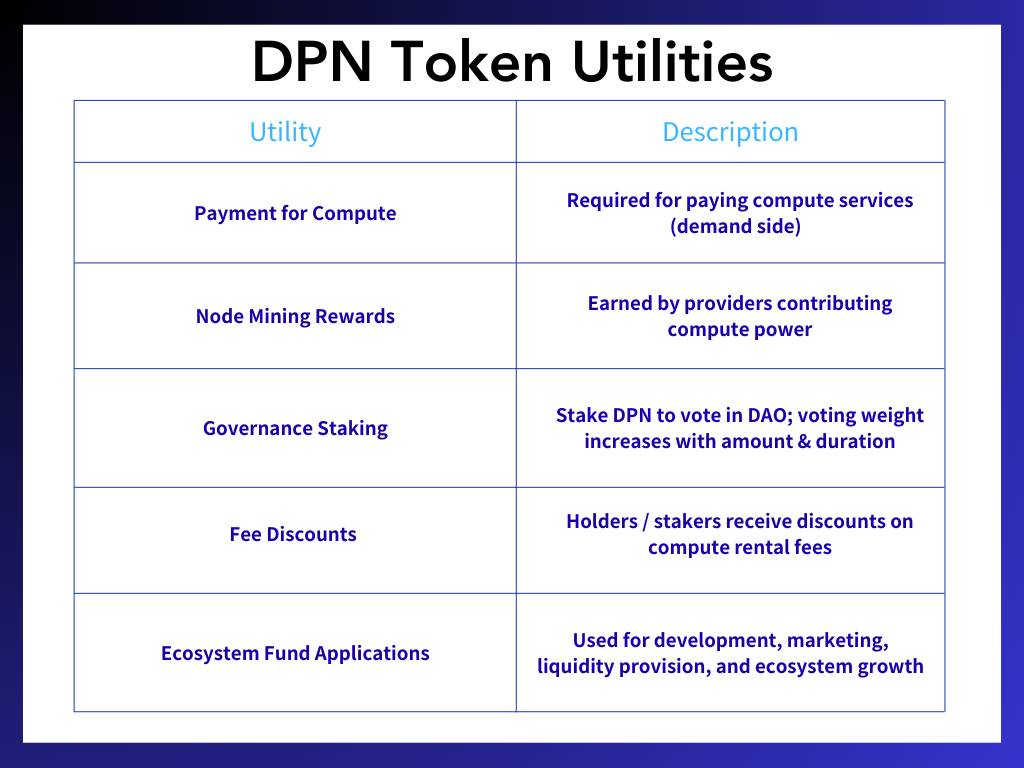
“DePIN’s ecosystem is built around four core roles, forming a powerful self-reinforcing positive cycle. Resource providers contribute hardware (GPUs/CPUs) as the supply foundation and continuously earn DPN rewards; task demanders (AI developers, enterprises, research institutions) pay DPN on-demand for high-performance compute; validation nodes stake DPN to monitor task quality and earn fee shares; developers and integrators build SDKs, plugins, and upper-layer applications to expand boundaries further. The ecosystem covers high-compute scenarios such as large-scale AI pre-training/fine-tuning, real-time inference, film-grade 3D rendering, hybrid storage-compute tasks, Web3 infrastructure acceleration (RPC nodes, on-chain indexing), and edge AI applications (autonomous driving simulation, smart city modeling). As node scale and task demand grow, more hardware joins to reduce average prices, attracting even more real usage and creating a strong flywheel with endogenous growth and anti-cyclical resilience.”

“DePIN’s decentralized compute network is naturally suited to a wide range of compute-intensive scenarios, delivering significantly lower costs and greater resilience than traditional cloud services. Key applications include large-scale AI model pre-training and fine-tuning, real-time inference services, film-grade 3D rendering and special effects production, hybrid distributed storage + compute tasks, Web3 infrastructure acceleration (such as RPC nodes and on-chain indexing), and edge AI applications (autonomous driving simulation, smart city simulation). These scenarios form the network’s initial demand sources and will continue to diversify as node scale expands. Whether for AI startup experimentation, academic research training, or enterprise edge computing exploration, DePIN provides reliable high-performance compute with 50–80% cost advantages, end-to-end privacy protection, and a globally distributed architecture.”
“DePIN’s roadmap is clearly divided into three phases: test validation, launch & growth, and long-term dominance. Milestones already achieved include the 2025 Q4 testnet launch with over 5,000 GPU nodes successfully connected and stability verified. The year 2026 marks the critical breakout period: Q1 sees the Mainnet Beta launch, IDO and exchange listings, plus global large-scale node recruitment; Q2 releases native integrations for mainstream AI frameworks (PyTorch, TensorFlow, etc.) to lower developer entry barriers; Q3 targets over 100,000 active GPUs, entering rapid growth. Long-term goals include exceeding 1 million globally accessed GPUs by 2028, becoming a major supplementary force in AI infrastructure, and by 2030 supporting large-scale distributed training at the AGI level while capturing a significant share of the global compute market. Driven by real demand and continuous incentives, the roadmap ensures a steady path from technical execution to ecosystem leadership.”
“DePIN’s ecosystem is built around four core roles, forming a powerful self-reinforcing positive cycle. Resource providers contribute hardware (GPUs/CPUs) as the supply foundation and continuously earn DPN rewards; task demanders (AI developers, enterprises, research institutions) pay DPN on-demand for high-performance compute; validation nodes stake DPN to monitor task quality and earn fee shares; developers and integrators build SDKs, plugins, and upper-layer applications to expand boundaries further. The ecosystem covers high-compute scenarios such as large-scale AI pre-training/fine-tuning, real-time inference, film-grade 3D rendering, hybrid storage-compute tasks, Web3 infrastructure acceleration (RPC nodes, on-chain indexing), and edge AI applications (autonomous driving simulation, smart city modeling). As node scale and task demand grow, more hardware joins to reduce average prices, attracting even more real usage and creating a strong flywheel with endogenous growth and anti-cyclical resilience.”
“DePIN’s decentralized compute network is naturally suited to a wide range of compute-intensive scenarios, delivering significantly lower costs and greater resilience than traditional cloud services. Key applications include large-scale AI model pre-training and fine-tuning, real-time inference services, film-grade 3D rendering and special effects production, hybrid distributed storage + compute tasks, Web3 infrastructure acceleration (such as RPC nodes and on-chain indexing), and edge AI applications (autonomous driving simulation, smart city simulation). These scenarios form the network’s initial demand sources and will continue to diversify as node scale expands. Whether for AI startup experimentation, academic research training, or enterprise edge computing exploration, DePIN provides reliable high-performance compute with 50–80% cost advantages, end-to-end privacy protection, and a globally distributed architecture.”
“DePIN’s roadmap is clearly divided into three phases: test validation, launch & growth, and long-term dominance. Milestones already achieved include the 2025 Q4 testnet launch with over 5,000 GPU nodes successfully connected and stability verified. The year 2026 marks the critical breakout period: Q1 sees the Mainnet Beta launch, IDO and exchange listings, plus global large-scale node recruitment; Q2 releases native integrations for mainstream AI frameworks (PyTorch, TensorFlow, etc.) to lower developer entry barriers; Q3 targets over 100,000 active GPUs, entering rapid growth. Long-term goals include exceeding 1 million globally accessed GPUs by 2028, becoming a major supplementary force in AI infrastructure, and by 2030 supporting large-scale distributed training at the AGI level while capturing a significant share of the global compute market. Driven by real demand and continuous incentives, the roadmap ensures a steady path from technical execution to ecosystem leadership.”
E-mail:service@dpncoins.com